4 questions to
Marine Lanier
1
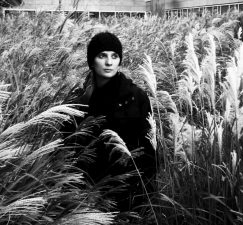
Marine Lanier, please tell us about your project, which you have been developing over several years in a series entitled Le Soleil des loups: you are interested in adolescence, but also – and perhaps above all – in the relationship between humankind and nature.
Le Soleil des loups is a series shot over several years in the Ardèche mountains, on the land of ancient volcanoes. There, I followed two teenage brothers growing up in an environment very close to nature. At this age of transformation, they still seem to belong to the wild world whilst gradually entering the world of adults. Through them, I seek not so much to tell their story as to explore a moment of transition – the moment when childhood fades away, when the body changes and when the connection with the landscape becomes a way of constructing one’s identity. Animals, forests, rocks and trees become presences that interact with human beings. My work often explores this boundary between documentary and fable.
I always start from reality, but I try to reveal its invisible, mythological or symbolic dimension.
2
The landscapes you photograph are very distinctive; can you tell us a little more about them? How did you choose this setting?
I never choose a landscape solely for its beauty. I look for places that already carry a history or a memory. For Le Soleil des loups, the ancient volcanoes of the Ardèche immediately fascinated me. These are very ancient landscapes, shaped by fire, which exude an archaic power. I like working in places where nature seems to retain a sense of autonomy, where you can still feel the great geological forces at work. These places become the breeding ground for my stories. I spend a lot of time exploring them even before I start taking photographs, to understand their light, their seasons and the relationships that develop there between humans, animals and all living things.
3
You sometimes photograph in colour, sometimes in black and white. What determines your choice? Are you inspired, for example, by fantastic cinema?
The choice between colour and black and white depends above all on what I’m trying to convey. Colour allows me to capture the texture, the light and a very physical sensation of the landscape. Black and white creates a different sense of time; it strips the image down to its essentials and sometimes gives it a more archetypal, almost mythological dimension. Cinema feeds my imagination greatly. I particularly love Charles Laughton’s The Night of the Hunter, where the landscapes become mental spaces, both real and imbued with the fairy-tale. I am also deeply drawn to the films of Werner Herzog, particularly Aguirre, the Wrath of God, Heart of Glass and Nosferatu, for the way he films a powerful natural world, indifferent to humankind, which seems to possess a will of its own. I also love the contemplative cinema of Béla Tarr, where the landscapes carry an emotional weight almost as strong as the characters. These films inspire me through the way they bring places to life. I, too, try to photograph landscapes that are not merely backdrops but genuine presences, capable of conveying a memory, a tension or an element of mystery. My work lies where reality reveals something older and more universal.
4
Next year you’ll be taking part in the Alt+1000 Festival in Switzerland, which exhibits photographs outdoors in the Neuchâtel mountains. The perfect setting for your work, and a premiere for you?
Yes, it’s an experience I’m looking forward to with great enthusiasm. My work is deeply connected to mountain landscapes, and seeing the photographs return to a natural environment creates a special resonance. They interact with the wind, the light, the trees and the terrain, almost as if they were returning to their original setting. It’s also the first time I’ve taken part in Alt+1000, a festival whose approach to bringing photography out of traditional exhibition spaces I greatly appreciate. I love the idea that visitors discover the works whilst out walking, in an experience where the real landscape extends the photographed landscape.